 © Florent Gardin
Practical Info
- PrerequisitesIntermediate
- Full Price150€
- Reduced Price120€
- Maximum Capacity13 persons
Basque Songs
Practical Info
- PrerequisitesIntermediate
- Full Price150€
- Reduced Price120€
- Maximum Capacity13 persons
Description
A course designed to immerse participants in the heart of the Basque oral tradition. Through a Basque repertoire, it will offer the opportunity to develop and enrich vocal technique by working on sound, breath, ornamentation and projection, both in solo singing and polyphony.
The course is open to people who already have experience in solo and/or polyphonic singing. It is not necessary to know how to read or write music.
At the time of registration, each participant will be asked to specify their level and their expectations for the course.
Program
In the Basque Country, passed down orally, singing is part of rituals, festivals and celebrations. Practised within the family, among friends, or during large gatherings, it is an artistic practice that also fosters social bonds and intergenerational transmission.
Over three days, the repertoire transmitted will focus on ensemble and shared songs from Iparralde, the Northern Basque Country. This transmission will be accompanied by work on breath, individual or polyphonic timbre, and resonance. You will also explore harmonics and vibrato.
On the evening of 22 July, participants from all the Errobiko Festibala courses — Basque, Georgian and Bulgarian singing, txalaparta, etc. — will take part, through song and music, in the banquet evening preceding the concert dedicated to Pedro Soler. More than a “presentation” or final showing, it will be a convivial moment of pluricultural sharing, centred around the pleasures of voice, music and the table.
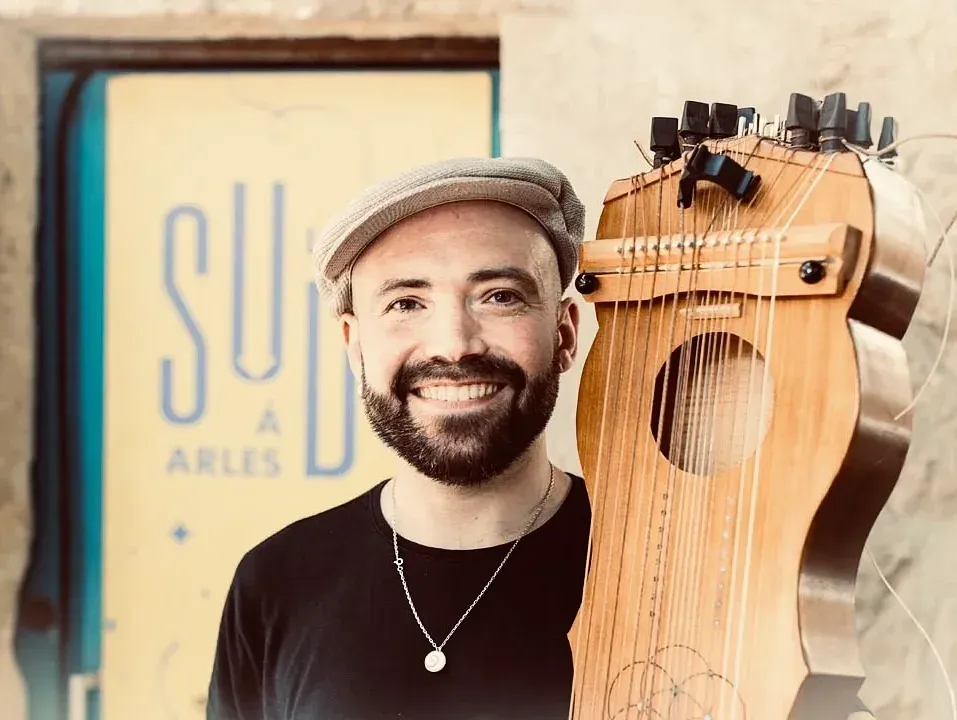
Julen Achiary
His artistic journey is rooted in his contact with Souletin singers, who have passed on to him, since childhood, a love of singing and of the basa ahaide. Through the rhythm of festivals and encounters, Julen Achiary has opened himself to the world and to the Tout-Monde. From the festivals of Uzeste and Itxassou to distant Congo, Turkey and Azerbaijan, he continues to weave connections between world music and the music of the Souletin Arbailles.
At the crossroads of all these heritages, he has developed a unique musical personality, expressed through a constant search for sounds and rhythms. The path he follows is one of openness, encounter and transmission, continually reborn through creation.